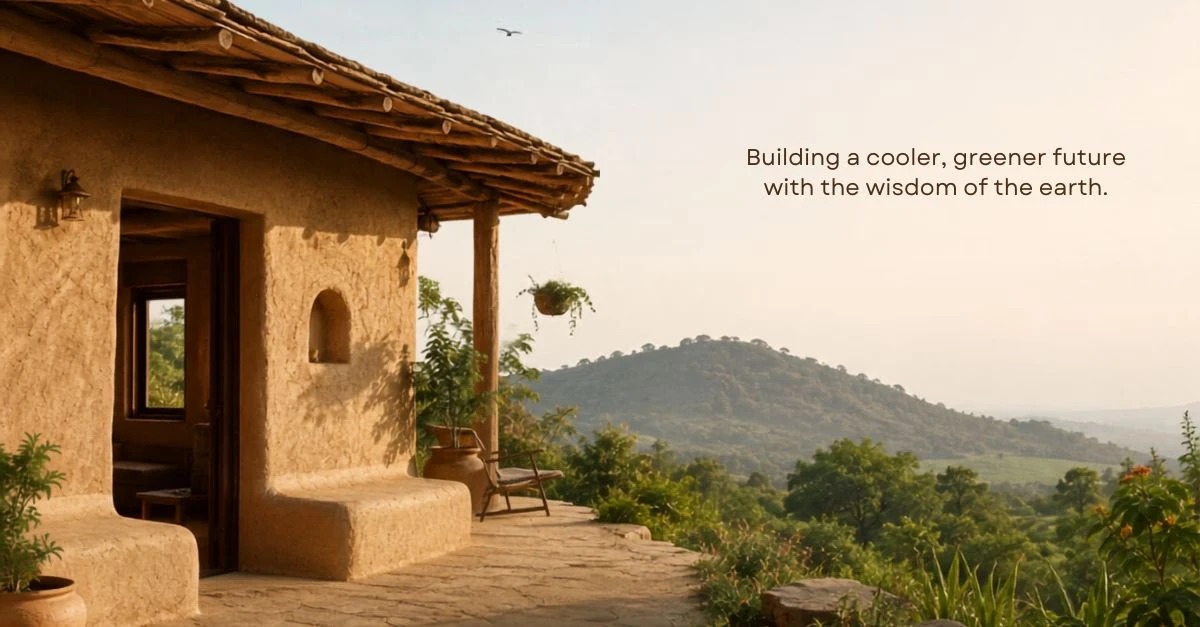
During my childhood, I spent my summer holidays at my grandmother's village house. It was a simple house made of mud with very thick walls. There were no air conditioner and no insulation as we know it. The only material used for walls was mud.
And even if it was very hot outside, inside the house, the temperature was always pleasantly cool. The coolness was definitely not like the one produced from an air-conditioning equipment. It was the kind that was so natural and wholesome that you hardly knew you were cool.
Once, I asked my grandmother why she didn't simply paint the walls white. She replied, "The earth knows what it's doing."
I thought that she was using metaphorical language. It happened she was being scientifically accurate.
The Science Behind Mud
I discovered many years later that mud keeps naturally a temperature 2-3C lower than concrete in summer. This is not a piece of a person's word but a fact that is tested and measured.
The most recent study carried out by the sustainable architecture department of IIT Delhi revealed that the temperature of mud walls is regulated by a process called hygroscopic regulation. Mud draws in moisture as the humidity goes up and lets it out as the air becomes dry thereby, keeping indoor humidity naturally at the perfect level of 40-60%. This is exactly the range of humidity in which human beings feel most at ease and comfortable.
How about modern concrete? It does the complete opposite thing. It retains heat. It holds moisture. No wonder your apartment made of concrete turns into an oven by noon of a hot day.
What We Have Missed
The emissions of greenhouse gases vividly depict the story. Producing a mud brick is linked to the emission of approximately 0.5 tons of CO2. But a cement brick is responsible for the release of 0.9 tons of CO2. Imagine a 2,000 sq. ft house, it is a difference of 50-100 tons of CO2 just for the construction phase.
The part which really surprised me was that mud really has a longer lifespan than concrete.
The forts in Rajasthan which were constructed using mud, stone, and lime continue to be interval after more than 500 years. Mehrangarh Fort. Nahargarh Fort. Functional. Living in them.
But the concrete buildings constructed in the 1990s are already showing serious signs of structural damage. Water seepage. Cracks. Deterioration.
The most ironic is that we perceive mud as being temporary, frail, and old-fashioned, while actually it is the complete opposite.
For the first-time mud architecture is recognized by UNESCO as sustainable heritage not because it is just a flashback, but the science confirms it.
As per research from AUROVILLE (a city which has been mud-based for more than 30 years in Tamil Nadu), buildings made of mud display excellent thermal performance, lower embodied energy, and similar structural durability to modern materials at a fraction of the cost.
The real issue
We didn't quit making with mud because it didn't work. We quit because cement is quicker. Mud requires knowledge - knowledge of local soil composition, climate variations, seasonal changes. You cannot just order it from a plant and expect the same results everywhere.
Knowledge disappeared. Convenience took the lead.
And we're the ones who suffer.
Average Gurgaon home bills are around 10,000-15,000 monthly for electricity, mostly used for air conditioning. That is 120,000-180,000 per year. All that for cooling a building, which was never supposed to need cooling.
Average Gurgaon home bills are around 10,000-15,000 monthly for electricity, mostly used for air conditioning. That is 120,000-180,000 per year. All that for cooling a building, which was never supposed to need cooling.
A mud villa that has been designed properly? The cost of AC goes down to 3,000-5,000 a month. Sometimes even less.
In 10 years, that will be around 900,000 to 1,200,000 energy cost difference.
Why it's so important now?
We are in double trouble; climate change and housing shortage. And the solution to the housing shortage is exactly the architecture which speeds up climate change.
Every new residential complex in Delhi, Gurgaon, Bangalore concrete boxes that demand not only AC, but also electricity and other sorts of external interventions to be liveable.
What if all we had to do was... to invoke that memory?
Nirvaana Hills and The Resurrection
Nirvaana Hills is actually staging a comeback of mud architecture. Still, not as a mere relic in museums. As a piece of functional design.
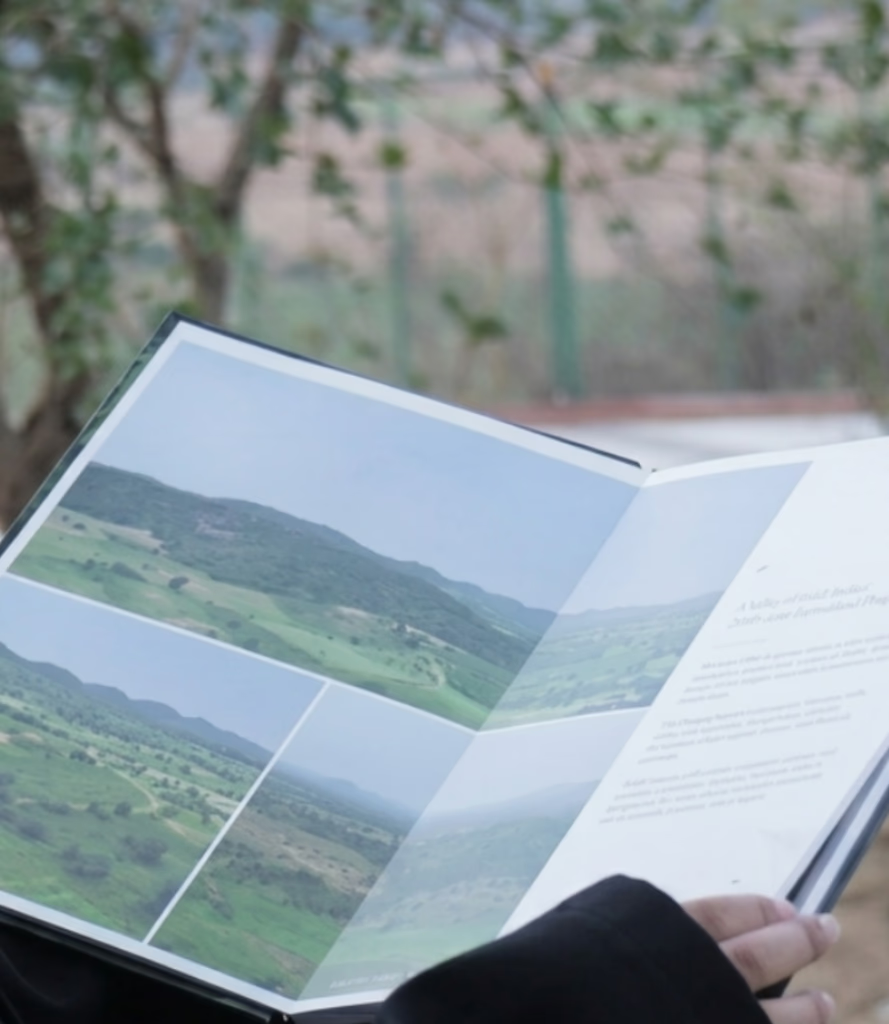
The mud villas at Nirvaana Hills are made of earth from the Aravalli region, the very natural material that has been part of this land for hundreds of years. The project recalls elements of the past that worked well (thick walls for thermal mass, proper orientation for passive cooling, ventilation methods) which alas, had been forgotten but are rediscovered now.
Newcomers will see the wisdom of my grandmother who did not have the science to back it. The regulated home. That does not counter the climate. That is one with it.
The Aravalli hills present a microclimate so special. The composition of the soil, the winds, even the seasons - the way they all come together to produce a natural cooling effect - is something concrete just shuts its eyes to.
Future is not backward
Half of it is not about turning our backs on progress. It is about admitting our fault.
Concrete gives one thing quite effectively: rapidity. For all other things strength, thermal comfort, environmental consequences, eventual expenses mud comes out on top.
We went ahead and optimized for the pace of construction versus the quality of life.
Nirvaana Hills is taking a different route.
The mud villas are not cheaper simply because they are backward. They are cheaper because they are effective. In their nature, it is the least amount of energy, the least amount of maintenance, and the least amount of continuous intervention that is required.
My grandma did not have to learn about thermal mass and hygroscopic regulation to come up with a dwelling that would remain cool without the need for electrical power. She just understood that mud 'did the trick'.
Now we have in our hands the knowledge of why it is so. And instead of using that understanding, we have turned a blind eye to it over these several decades.
Nirvaana Hills is responding to the Earth’s wisdom.
Maybe, it is about time we all pay attention to it.